
Automating insurance claims is one of the biggest transformation challenges facing European insurers today. Poor data quality, outdated legacy systems, and internal skills gaps are the three most common reasons projects stall — together accounting for more than half of all barriers reported by claims professionals surveyed across Europe.
The Adacta State of Claims Automation Market Survey 2026 gathered insights from 110 insurance professionals across five European regions — DACH, Eastern Europe, the UK and Ireland, Benelux, and Southern Europe. Participants included C-suite executives, claims transformation leads, and implementation team members, all asked the same open-ended question about what is actually blocking automation and what helped them move forward.
We asked them a single open-ended question: What challenges or lessons have you encountered in trying to automate claims, and what did or would help you most to overcome these barriers?
Their answers reveal a consistent set of barriers. And while each organisation faces its own context, the patterns are remarkably similar across markets and seniority levels.
Table of contents:
- Seven barriers that keep coming up
- Poor Data Quality Undermines Automated Claims Processing
- Legacy systems create an integration bottleneck
- The Claims Management Skills Gap Is a Change Management Problem
- Additional Challenges in Claims Processing Automation
- Five Takeaways for Claims Processing Leaders
- About the survey
Seven barriers that keep coming up
After categorising all 110 responses by primary challenge, seven themes emerged. Some responses touch more than one, but each was assigned to its dominant barrier.
Data quality and structure was cited by 25% of respondents, making it the single most dominant barrier to claims automation in our survey.
Here is how the challenges break down across the full sample:
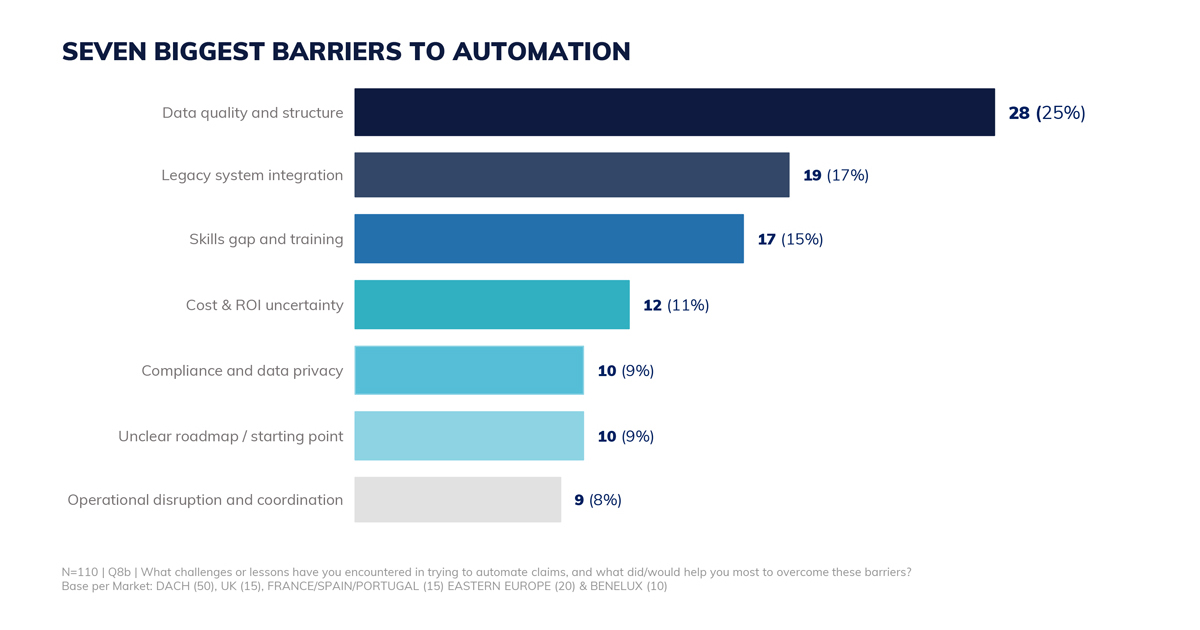
The top three barriers alone account for well over half of all responses. Let us look at each one in more detail.
Poor Data Quality Undermines Automated Claims Processing
One in four respondents named data-related issues as their primary obstacle. The specific problems vary, but they share a common root: automation cannot succeed on a weak data foundation.
Respondents described incomplete records, duplicate entries, format mismatches between systems, unstructured documents that resist machine processing, and failed data migration projects. Several noted that problems only became visible after machine learning and automation was already underway, turning what seemed like a technology challenge into a data remediation exercise.
The solutions that helped were largely platform-level: validation checks that catch errors at the point of entry, standardised data formats across systems, centralised data models that reduce duplication, and auto-fill features that limit reliance on manual data entry.
"We faced problems with poor data quality and so we implemented validation checks." — Head of Data & Analytics, France (Adacta, State of Claims Automation 2026).

The lesson here is straightforward. Before investing in advanced automation or AI (Artificial Intelligence) capabilities, insurers benefit from getting their data house in order. Validation, standardisation, and centralisation are not glamorous, but they determine whether everything built on top of them will work.
Legacy systems create an integration bottleneck
Nearly one in five respondents described outdated infrastructure as a blocking factor. The current systems in place were not designed to integrate with contemporary claims processing or automation tools, and efforts to achieve such integration have been slow, costly, or both.
Respondents highlighted the use of "old computer systems," "outdated infrastructure," and systems that "lack compatibility with AI integration." Several mentioned that the challenge is both technical and organisational. Identifying suitable consultants, ensuring connectivity between operational systems, and addressing internal knowledge deficiencies contribute to the complexity of the issue.
"Problems with connectivity between operational systems, difficult search for proper consultants, missing internal know-how." — Head of Claims Technology, Eastern Europe (Adacta, State of Claims Automation 2026).
The respondents who moved past this barrier typically did so with external vendor support, platform upgrades, or by implementing modern integration interfaces that bridged the gap between old and new.
The Claims Management Skills Gap Is a Change Management Problem
Fifteen percent of respondents pointed to a lack of technical skills and knowledge within their teams. But the responses suggest this is not simply a training deficit. It is a change management challenge.
Some teams lacked the technical knowledge to work with automation tools. Others understood the tools but struggled with adoption because internal processes had not changed. Several respondents noted that staff continued using old methods because the new ones felt unfamiliar or complex.
"The use of automation requires vast technological knowledge. Upskilling ourselves would solve it." — Claims Transformation Lead, UK (Adacta, State of Claims Automation 2026).
The solutions respondents found effective were notably practical: hands-on training rather than theoretical instruction, visual workflow tools that make automation logic transparent, simple user guides, and in some cases hiring dedicated Artificial Intelligence specialists to support the broader team.
This pattern suggests that ease of use matters as much as capability when selecting automation tools. A powerful system that the team cannot operate independently is not yet a solution.
Additional Challenges in Claims Processing Automation
- Cost and ROI uncertainty
Twelve respondents cited high implementation costs and unclear return on investment. Interestingly, the barrier here appears to be communication rather than price itself. Multiple respondents noted that once the long-term value of automation was clearly articulated, budget approval followed. The issue is not that automation is too expensive but that its benefits are not always presented in terms that decision-makers can act on.
- Compliance and data privacy
Ten respondents raised concerns about regulatory compliance, particularly around AI-based decision-making. As automation takes over more claims decisions, demonstrating compliance becomes harder. Respondents wanted clearer guidance on how automated claims processing meets regulatory standards and built-in compliance features that reduce the burden of manual oversight. With regulations like DORA now in effect, this concern is likely to grow.
- Lack of Clear Automation Starting Point
Ten respondents described not knowing where or how to begin. This is a strategic gap, not a technical one. The most effective solution, according to respondents, was a structured implementation roadmap for the automated claims process. One respondent provided practical advice in the survey. Begin with high-volume, low-complexity claims. Develop from that point onward.
- Operational disruption during transition
Nine respondents reported system crashes and constant updates disrupting automated workflows. They also mentioned challenges in coordinating with multiple vendors and difficulties in achieving internal alignment. These issues are transformation costs that rarely appear in business cases. However, they consistently emerge in project retrospectives.
Looking across responses, the solutions and enablers that respondents found effective cluster into four categories.
On the technology side, respondents valued validation checks, centralised data models, real-time dashboards, smart linking and matching tools, auto-classification engines and robotic process automation (RPA) tools. These are not standalone products. They are platform-level capabilities that respondents want embedded in their core claims system rather than added as separate tools, helping improve efficiency and customer satisfaction in claims handling.
On the process side, structured implementation roadmaps, standardised templates, phased rollout approaches, and clearer documentation rules helped teams optimise claims processing workflows and move from confusion to execution.
For people and change management, hands-on training, visual workflow tools, simple guides, dedicated AI specialists, and clear guidance on working with AI agents made the difference between adoption and resistance.
To build a business case, teams rely on ROI reviews, clear budgeting guidance, and built-in compliance features. Performance analytics also play a crucial role. These elements help justify investments in automated claims processing. They are essential for maintaining stakeholder confidence in insurance claims transformation initiatives.
About the survey
The Adacta State of Claims Automation Market Survey 2026 collected responses from 110 insurance professionals across five European regions: DACH (45%), Eastern Europe (18%), UK and Ireland (14%), France, Spain and Portugal (14%), and Benelux (9%). Respondents include C-suite executives, directors, claims transformation leads, and senior managers working across personal auto, property, commercial, and specialty lines of business. The majority (68%) are directly involved in implementation teams, with the remainder serving as key decision-makers or project sponsors.
This post is part of the Adacta State of Claims Automation Market Survey 2026 report series.